A Family Curriculum That Restores the Missing Education on How to Guide Your Family
TAKE THE FAMILY STRENGTH ASSESSMENT
FAMILY STRENGTH ASSESSMENT · SEQUENCED CURRICULUM · WRITTEN FAMILY PLANS · ONE COMPLETE FAMILY OPERATING SYSTEM

The Most Important Job You Will Ever Have Didn't Come With Instructions
This isn't one problem. It is three, and they all trace back to the same missing piece. No one ever handed you instructions for this job, so you built your own out of whatever worked in the moment, and instructions built that way were never going to hold.
- You are the one holding it together, even on the days someone else is standing right there with you. The chore chart worked for two weeks, then it did not, and now you are asking twice and doing it yourself the third time. You come home carrying whatever the day already gave you, and the house is waiting with its own list, with no line between where one ends and the other begins.
- Sibling arguments start before breakfast is finished and end somewhere after dinner. Asking them to stop rarely holds for more than an hour. You have said the same instruction so many times that raising your voice has become the only version of it that gets a response, and you do not like what that has become either.
- Getting your spouse on the same page about any of this takes its own negotiation, separate from the one already happening with the kids. If there is a teenager in the house, add a different kind of resistance to all of it, one that looks less like a phase and more like a daily standoff.
You Are Not Alone. Parents Everywhere Are Saying the Same Thing.
The education on how to run a household was removed from schools decades ago. What you are looking at below is what that gap looks like today.
63M parents
in the U.S. are raising children under 18 right now, carrying this at the same time you are.
This is not a small or isolated experience. It is the shared condition of the majority of parents raising kids today.
41% of parents
say that most days, they are so stressed they cannot function.
That is four out of every ten parents in a room full of them, saying the same thing you might already know about your own days.
70% of parents
say parenting is harder now than it was 20 years ago.
Whatever is different about your daily load compared to your own parents' generation, most parents feel it too.
Source: Office of the Surgeon General's advisory, "Parents Under Pressure: The U.S. Surgeon General's Advisory on the Mental Health and Well-Being of Parents," published by the U.S. Department of Health and Human Services, August 2024.
Building Stable Families Through Restored Education.
Every parent asks the same question at some point. Where is the instruction book? Why does a baby come home from the hospital with no manual, no guide, no course completed beforehand? The answer is not that it never existed. It did. It was removed.
38% decline in a single decade
Family and Consumer Sciences (Home Economics) enrollment fell from 5.5 million students in 2003 to 3.4 million by 2013, a national decline documented through Purdue University's ongoing field surveys.
Fewer than 7% of students
By 2013, fewer than 7 percent of American students were receiving this education, against a total K-12 population of roughly 50 million. The instruction book existed. It reached a small fraction of the people who needed it, and it is even less today.
Dropped out of national curriculum
For most of the 20th century, this course was a standard part of American secondary education, taught in nearly every high school in the country. Today it survives in a small number of states and districts, no longer something every parent can expect to have.
The parents seeing lasting results are not doing it with another tip or a new technique. They are working from a system built the way this education used to be delivered, sequenced, complete, and given before the responsibility began.
Create Family Institute is modernizing and restoring the family education that was removed.
Source: Carol Werhan, Family and Consumer Sciences teacher educator, Purdue University, national field survey data, as reported in Fatherly, "How America Abandoned Home Economics And Made 'Adulting' An Achievement"; U.S. Department of Education enrollment data, 2003 and 2013Source: NPR, "Despite A Revamped Focus On Real-Life Skills, 'Home Ec' Classes Fade Away"; Salon, "We need home economics now more than ever"; Fatherly, "How America Abandoned Home Economics And Made 'Adulting' An Achievement"
You Don't Need Another Expert Telling You How to Run Your Family.
There is a reason the question follows every parent for years:
Where is the instruction book? What was I supposed to already know?
That question does not go away because it never gets answered. It sits underneath every decision until something changes.
When you have your own direction for your family, something shifts. Not because the day gets easier. Because you stop measuring every decision against someone else's opinion and start measuring it against something you built yourself.
You stop needing the next article, the next expert, the next piece of advice from someone who does not know your family. You already have the thing they were trying to hand you. A direction that is yours.
That shift is not small. It is what allows you to stop searching outward and start investing inward, into your own family, your own future, the thing you are actually building. Every hour spent looking for outside answers is an hour not spent building what only you can build.
This is not a soft comfort. It is the difference between reacting to whatever you find and guiding your family toward something you named yourself. And it is the direct result of finally having the one thing every other resource leaves you without.
Your own direction.
I did not realize how much I was reacting all day until I started applying this. Now I feel like I actually know what I am doing. Things are not perfect, but they are steady. That is new for us.
Megan R.
When the Education Comes Back, the Family Changes.
The U.S. Surgeon General issued an advisory in 2024 stating that 41% of parents report that most days they are so stressed they cannot function. Nearly 50% say the stress is completely overwhelming.
There was a time when the education to run a household was taught. Home Economics was not just cooking and sewing. It was the curriculum of how a home operates, how a family sets direction, manages resources, divides responsibilities, and holds together when life gets hard.
That education was removed. The expectation that families would figure it out remained.
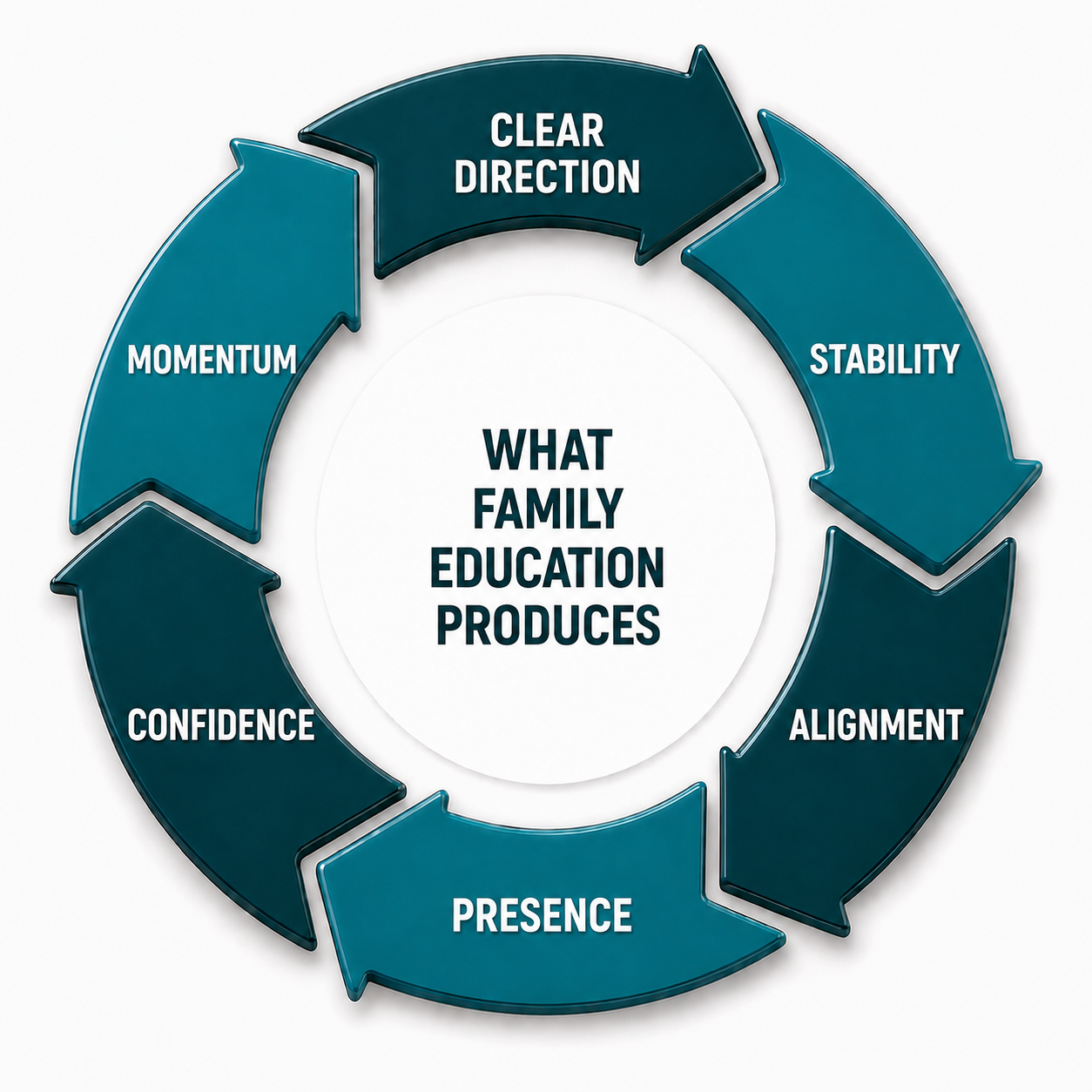
Create Family Institute has restored it. Through a sequenced curriculum, parents learn what was never replaced, the operating principles of running a household with intention and direction.
Source: U.S. Surgeon General's Advisory on the Mental Health and Well-Being of Parents, August 28, 2024; Create Family Institute Community Pilot, March through August 2024, 22 participants
"This gave me structure when I felt like I was carrying everything alone."
Brittney, pilot participant
"I finally feel like we have a system instead of just surviving the week."
Tiffany, pilot participant
"I stopped micromanaging and started leading."
Rachel, pilot participant
"One of the best mornings we have had all school year. Now I don't hope that my son sleeps in. I look forward to waking him up and having our mornings together as a family."
Kasey, pilot participant
How the Program Works.
One course every month. Learn it, implement it, set it, then move to the next. Each course is built from three modules of micro lessons and interactive workbooks, so every step produces a plan you can actually use, not just information you have to figure out how to apply on your own.

Step 1: Take the Family Strength Assessment
Ten categories, free, taken immediately. This shows you exactly where your household needs direction across every area of family life.
Step 2: Build Your Family Vision
Interactive prompts guide you through naming three visions, your Parenting Vision, your Child's Vision, and your Family Vision. These three become the destination every course after this is built to move you toward.


Step 3: Family Direction Unlocks
Your first course, averaging two and a half hours to complete. You implement it for the rest of that month before the next course begins.
Step 4: One Course Every Month, For the Rest of the Year
The remaining courses continue on the same rhythm, one course, one month, one plan implemented, all the way through the full curriculum.

Ready to see all eleven courses?
Every course. Every plan.
One subscription.
One course unlocks every thirty days. Each course produces one written plan. The plans build on each other until you hold a complete written foundation for every area your family operates in.
Everything Included in Every Plan
One written plan per course · One course released every thirty days
Oh my Gosh!! Now I feel like I have a GPS to get to my destination. Of course, I would love to do the next course. Thank you again.
Miriame B.

A Season With the System
22 Parents | 6 Months
Every parent in this pilot was already doing everything right. Working. Showing up. Trying hard. What was missing was not effort. It was a plan.
Over six months, parents carrying full-time jobs and full households learned to build direction instead of reacting day to day. Every single parent stayed through the whole six months. Every one of them was still using what they built afterward, not because they had to, but because it worked.
"I finally feel like we have a system instead of just surviving the week."
Tiffany, pilot cohort participant
Families Who Cannot Afford to Get It Wrong
3rd Special Forces Group | 69 Families
Military families live with a kind of pressure most households never face. When one parent deploys, the household does not pause. It has to keep running, on schedule, without them.
CFI's curriculum was delivered directly to active duty Special Forces families during a private family weekend. 88 percent said it helped their household. 91 percent said it spoke directly to what their family actually needed.
If a system can hold under that kind of pressure, it can hold in any home.